
4 MINUTE READ
‘Tis the season for PIE! Holiday pies are the cornerstone of our gatherings with family, friends, and loved ones. If you’ve got pie on the mind this holiday season, take a deep dive with us into the history of traditional holiday pies around the world and across different traditions. Who knows? Maybe you’ll adopt a new pie tradition into your life! So pull up a chair and get cozy, we’re serving up Holiday pies for:
Thanksgiving
Christmas
Pie Day (Pi Day)
Shavuot
Fourth of July
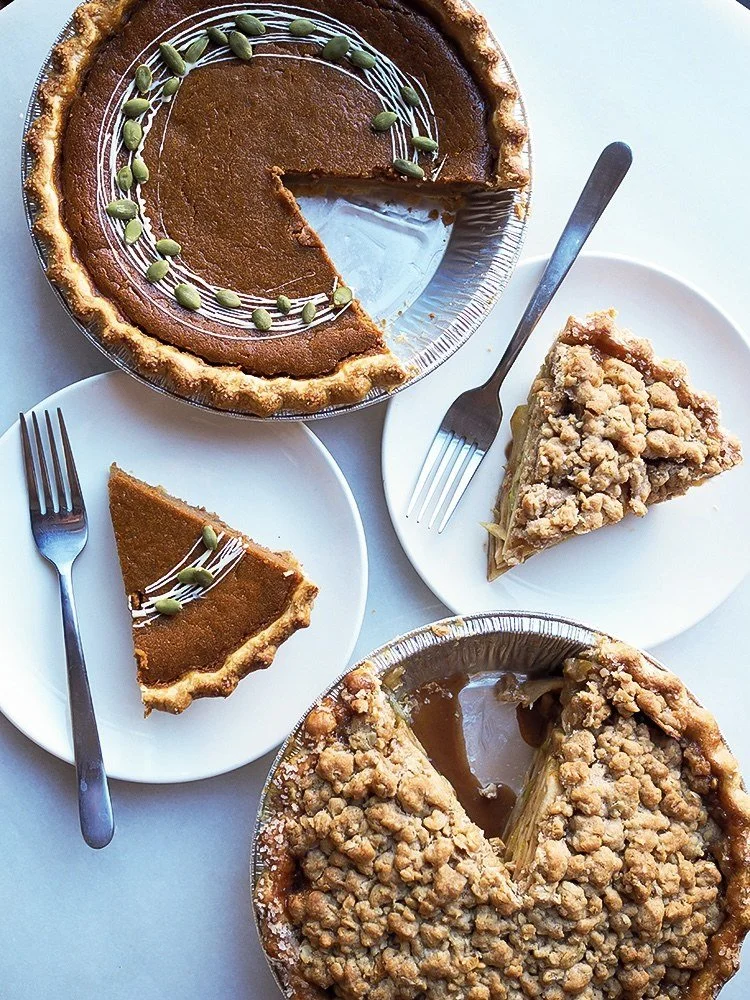
1. Thanksgiving’s Most Popular: Pumpkin Pie
Pumpkin pie is undoubtedly the most common of holiday pies at Thanksgiving. A custard pie made from seasonally harvested pumpkin crops, the influence of pumpkin pie on Thanksgiving has even expanded beyond the pie and beyond the holiday. You know what I’m talking about: Pumpkin Spice! If you’ve ever had a PSL (pumpkin spice latte, for the uninitiated), you already know what is in pumpkin pie spice: cinnamon, nutmeg, ground ginger, and cloves form the basic blend. Some bakers add allspice, black pepper, even a tiny bit of cayenne (and a pinch of love?) to their secret recipes for pumpkin spice. So, is pumpkin pie healthy? Pumpkin is high in fiber and contains vitamin A, so it is a part of a healthy diet in moderation! If you find yourself with too much, get creative with what to do with leftover pumpkin pie filling: swirl it into brownie mix and bake pumpkin pie brownies, or dredge slices of bread into the sweet pumpkin custard to make french toast for Thanksgiving breakfast!
2. Britain’s Christmas Tradition: Mince Pie
After pulling open the Christmas crackers and donning their paper crowns, Britons tuck into a midday holiday meal including mince pies. Mince pies once commonly included minced meat such as beef or venison, but many versions today are simply a spiced fruit and nut mixture often including apples, raisins, and walnuts. These holiday pies are so traditional that their ancient history is hard to trace precisely, but it is generally accepted that mince pies first came on the scene in the 11th century, when Crusaders brought back spices from the Middle East including cinnamon, nutmeg, and clove (the origin of pumpkin spice?). When British colonization of the West Indies granted access to sugar plantations, the mince pie became more sweet than savory, so the mince pie is a British tradition with an extensive global history and far-reaching roots. The mince pie is not as common outside of the UK today, but in Britain, mince pies are popular and symbolic. British grocery chain Morrisons reports that Brits consume an average of six mince pies each December, and it is customary to make a wish upon eating your first mince pie of the holiday season. Sweet!
3. Pi Day: All Things Pie
Millennials love a pun, and Pie Day/Pi Day is peak Millennial optimism meets Twitter inside joke. Celebrated on March 14, Pi Day marks the date 3.14, an abbreviation of the expression of pi, which is the mathematical constant that explains the relationship of a circle’s circumference to its diameter. The first Pi Day was celebrated on March 14th, 1988 at the San Francisco Exploratorium, when physicist Larry Shaw hosted an event to make mathematics more fun. What’s more fun than eating pie? Since pies are circular, and the pronunciation of pi sounds like “pie,” it’s punny fun to celebrate Pi Day with holiday pies. Fruit pies, cream pies, pot pies, even pizza pies make popular choices. Get in on the fun by decorating your holiday pies with the pi symbol, memorizing the digits of pi, and sharing joy in mathematics – and tasty baked treats, of course! The best NY bakery to get pies for the holidays is The Good Batch Bakery in Brooklyn, NY. Stay tuned to our Instagram to see our rotating seasonal specials of holiday pies, for all of your holidays!
4. Shavuot: Late Night Cheesecake
Shavuot is one of the most obscure, and least celebrated Jewish holidays on the calendar – but you might want to change that when you learn that it’s usually celebrated by staying up late and eating cheesecake! I’m all for any celebration that gives me an excuse to eat holiday pies, and Shavuot takes place seven weeks after Passover, around the time of the grain harvest. Shavuot celebrates both the harvest, and the giving of the Torah to Moses on Mount Sinai. It is customary to read the Book of Ruth, whose events take place also during the harvest time. Staying up all night to study the Torah is another Shavuot custom. So where does the cheesecake come in? Perhaps it’s because Psalms 68: 16-17 calls Mount Sinai Har Gavnunim, which sounds like gevinah, the Hebrew word for cheese. Perhaps dairy is eaten in reference to Song of Songs, where King Solomon wrote that the Torah “Like honey and milk, it lies under your tongue.” In any case, it is an Ashkenazi tradition to eat cheesecake on Shavuot during late-night Torah study. Now for the big question: is cheesecake a pie? With a crust at the base, and a filling of baked custard, cheesecake is considered to be either a tart or a pie. So this counts as one of our holiday pies on the pie calendar!
5. Fourth of July: As American As Pie
Since it was brought over by our colonial British ancestors, Americans have adopted pie as one of our iconic traditions. The Fourth of July, our holiday of independence, centers all things we have incorporated into our American identity: baseball! Hot dogs! Fireworks! And, of course, holiday pies. Serving up a sweet slice at a backyard barbecue or block party is a time-honored tradition, and due to the summer season during which the holiday takes place, fresh fruit pies are the pies of choice. Berries just coming into their ripeness at this time include strawberries, raspberries, blueberries and blackberries. Creative bakers use a combination of these red-and-blue berries to make Fourth of July holiday pies that invoke the American flag! Across the US, many proud pie traditions are baked to boast regional heritage and specialties, and to celebrate the pie in history. A history that dates back further than you might even imagine…
